
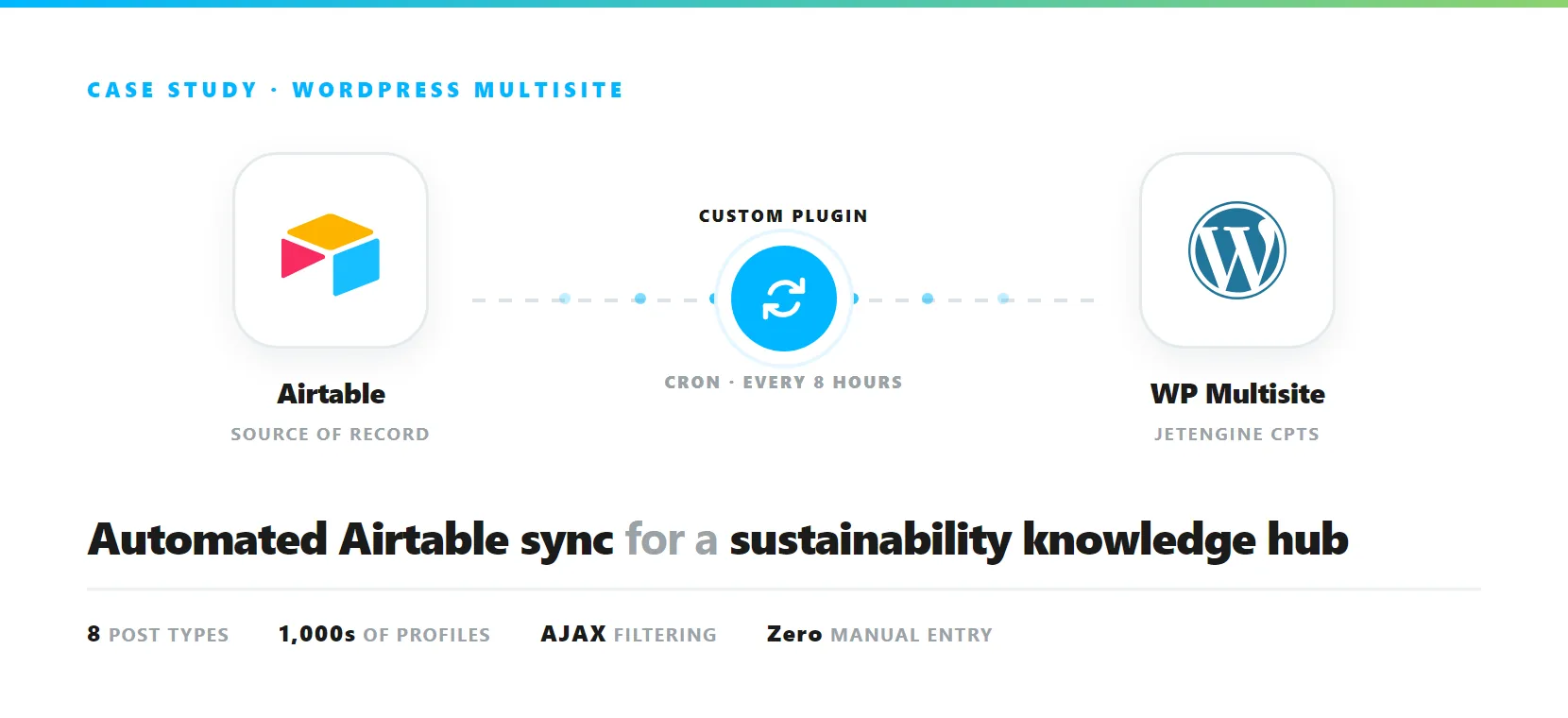
This WordPress Multisite build carries Het Groene Brein, the Netherlands’ knowledge hub for sustainable innovation, which connects scientists to the businesses and policymakers who need their research. Because the site had to carry thousands of researcher profiles and link each one to the projects, programmes and publications they work on, a single WordPress install was never going to hold up: queries slowed as content grew, so the platform quietly discouraged the growth it existed to support. Rather than keep stacking post types onto one heavy install, we rebuilt it as a WordPress Multisite with eight JetEngine post types and real relationships between them, so a visitor moves from a researcher to their projects and publications as one connected body of work. The complication was that the team maintains researcher records in Airtable, and a website copy of that data drifts out of date within weeks. We built a custom plugin that syncs Airtable into WordPress every eight hours, with fallback images and error logging so a partial failure is visible rather than silent. Profiles now update themselves, and thousands of interlinked posts stay filterable without a page reload.
The Challenge
Het Groene Brein wanted a living knowledge hub rather than a brochure. In practice that meant four things at once:
- Thousands of scientist profiles (Wetenschappers), each with their own page
- Projects, programmes, publications and thematic content alongside them
- Real relationships between those content types, not a taxonomy standing in for one
- Front-end filtering fast enough to feel instant
The existing monolithic setup struggled on all of it. Queries were slow, the content relationships were tangled, and every profile update was done by hand. Adding a content type made the whole site heavier, so growth carried a penalty.
Splitting the Install: WordPress Multisite
We migrated to WordPress Multisite and split the content across separate sites. Large datasets stop competing with each other, and the query cost of any one section no longer scales with the size of everything else.
- Faster queries and reduced server load
- Large custom post type datasets kept separate from one another
- Room to add post types such as Agenda and Vacatures without touching the rest of the platform
Modelling the Content: JetEngine Custom Post Types
We used Crocoblock’s JetEngine with Elementor Pro to build the content model: eight custom post types, with genuine relationships between them.
- Post types: Wetenschappers, Projects, Programs, Publications, Themes, Agenda, Vacatures, Special Projects
- Relationships: scientists linked to the projects, programmes and publications they contribute to
- Templates: Elementor Theme Builder single and archive layouts, built per post type
The payoff lands on both sides of the login. Content managers link a scientist to several initiatives without duplicating anything, and visitors read a researcher, their projects and their publications as one connected body of work instead of four disconnected lists.
Making It Searchable: AJAX Filtering
A directory of thousands of profiles is only useful if you can narrow it quickly. We implemented front-end filtering with JetSmartFilters so results update in place, with no page reload between one refinement and the next.
- Filter scientists by theme, SDG and availability
- Profiles open in dynamic pop-ups rather than a full page load
- Results update in place as filters are applied
Keeping It Current: The Airtable Sync
This was the part that decided whether the rest would hold up. The team already maintained researcher records in Airtable, so the website needed to follow that source rather than become a second copy of it.
Maintaining the profiles by hand was never going to scale. The site had to follow the source of record, not compete with it.
We built a custom WordPress plugin to sync Airtable into WordPress on a schedule, with enough operational control that the team is never locked out of it:
- Scheduled sync: a CRON job every 8 hours, updating profiles automatically
- Media handling: images sync across, with fallback images where a photo is missing
- Manual override: a sync button in the admin for when an update cannot wait
- Error logging: failures are recorded rather than silently skipped
The fallback images and the error log matter more than they sound. A sync that half-fails without telling anyone is worse than one that does not run at all, because you carry on trusting data that stopped updating weeks ago.
Special Projects as Mini-Sites
Het Groene Brein regularly launches initiatives that need their own identity without being spun out onto a separate domain, so we built a mini-site architecture inside the platform.
- Dedicated landing pages, menus and footers per initiative
- News archives and single-post templates isolated per project
- Still served from the main domain, so search equity stays where it was built
New initiatives go live without a redesign, and without the team booking developer time to get one online.
Performance and SEO
- Lazy loading and optimised database queries
- Yoast SEO for indexing and rich snippets
- Dynamic breadcrumbs and meta boxes to strengthen internal linking
- Optimised excerpts and content blocks across archive templates
WordPress Multisite Technology Stack
- Platform: WordPress Multisite across several sites
- Page building: Elementor Pro with Elementor Theme Builder
- Content modelling: Crocoblock JetEngine, JetSmartFilters
- Integration: custom WordPress plugin against the Airtable API, on WP-Cron
- SEO: Yoast SEO, dynamic breadcrumbs, structured internal linking
Results
- Scientist profiles sync from Airtable automatically, with no manual data entry
- Thousands of interlinked posts are searchable and filterable without page reloads
- New content types can be added without slowing the rest of the platform
- New initiatives launch as mini-sites without a redesign
Conclusion
The useful lesson here is not the plugin list. A content platform fails at its seams: between post types that should be related, between a directory and the data that feeds it, between the main site and whatever the team needs to launch next. WordPress Multisite fixed the query cost, JetEngine fixed the relationships, and the Airtable sync fixed the one that would have quietly undone the rest.
The content model runs on Crocoblock JetEngine, and the profile sync talks to the Airtable Web API. For related work, the stock management software is another custom system built around an external data source, and the recruiting agency website is a WordPress and Elementor build from the same stack.
Need a WordPress platform that can carry this much content? Request a quote and we will scope it with you.